Public Blockchain Network are perfect for SME Segment
In the recent past we can see that there is a lot of interest in the public blockchain networks like Bitcoin, Ethereum and others. There has been a gradual increase in the institutional adoption of digital assets. The use case of store of value is slowly getting attraction from wealthy people, retail and institutional investors.

Blockchain Technology
Existing infrastructure, in no doubts, worked well, but never could solve the problem of scaling and real time interoperability to be able to be widespread enough to far reaches of the world. For enabling global trade with local systems there is a need for a global inter-connectivity payment rails. The currently running bottom up approach for creating this financial pipeline/payment rail is not yet able to make it real time but at the same time, low fee/cost to process.
With Blockchain solutions, we seemingly can look at an alternative, where there are no centralized router performing legal checkpoints, but a fully transparent but private transaction log in a public ledger. Lets examine this network which currently exists with comparison to the proposed blockchain based network using Proof of Work.
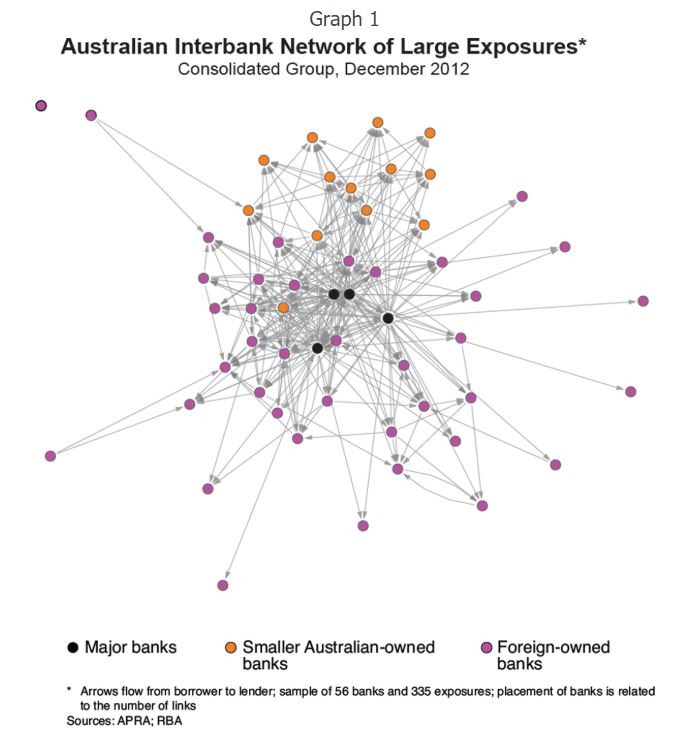
Network
Picture shows data from Central bank of Australia (Link) and a network representation for their bank network.
A small world network (i.e. small network distance) is a network with the property that the shortest path length is smaller than the logarithm of the network size (i.e. the number of nodes aka "six degrees of separation" ).
This is known as a Mandala network which looks as shown in the picture(Link). If you see in the below picture this small world network provides quicker network routing between all endpoints. This enables the transaction flow in the network really real fast.
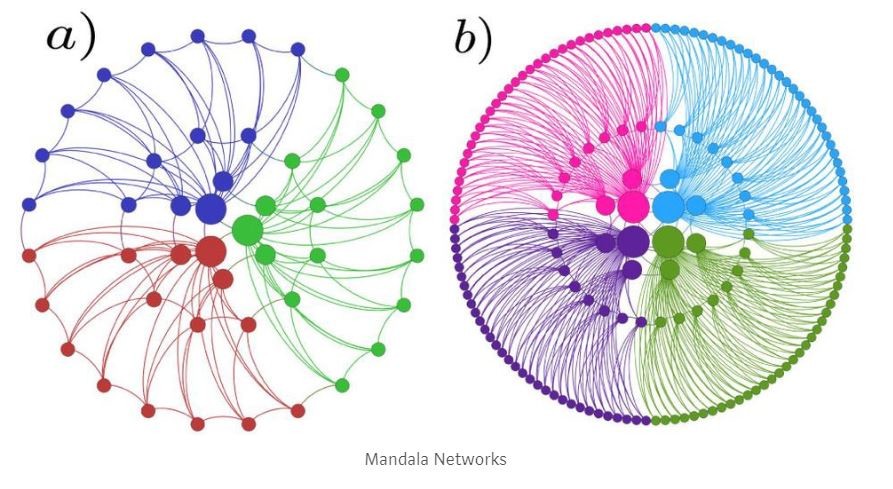
Network structure
In the above diagram, at the center will be the third parties, in a PoW Blockchain, that will be the miners(core of the network), the merchants are the middle layer, and users are the outer layer. This provides a really quick network connectivity (6 or less hops) between any two end points in the network making it a good fit for being used as global financial network which is trustless as well.
Why Public Blockchain Networks Matter
A public blockchain network is a decentralized ecosystem that:
- Is permissionless and open to anyone
- Has transparency and immutability as core principles
- Runs on a consensus mechanism for trust
- Operates without central authorities
Public blockchain networks offer various advantages, particularly for small to medium enterprises (SMEs) that may face barriers with traditional business and financial systems.
Challenges Faced by SMEs
Small and medium businesses around the world face numerous challenges:
- Limited access to credit and capital markets
- High transaction costs
- Complex cross-border payment systems
- Limited technological resources
- Difficulties establishing trust with larger entities
- Inefficient supply chain management
Potential Use Cases for SMEs
1. Transparent Supply Chain Management
Public blockchain networks can help SMEs create transparent supply chains that enhance trust and efficiency:
- End-to-end traceability of products
- Irrefutable proof of origin and quality
- Automatic verification of compliance with standards
- Reduced counterfeiting and fraud
This can be particularly valuable for SMEs in sectors like agriculture, pharmaceuticals, luxury goods, and manufacturing.
2. Efficient Cross-Border Payments
International payments remain complicated, slow, and expensive, especially for smaller businesses:
- Blockchain enables near-instant settlement
- Reduced transaction costs (no intermediaries)
- 24/7 operation (no banking hours)
- Programmable payments through smart contracts
3. Alternative Financing Options
SMEs often struggle with limited financing options due to:
- Stringent lending requirements from traditional banks
- Limited credit history
- High interest rates
Public blockchain networks offer alternative financing models:
- Tokenization of assets
- Crowdfunding through token sales
- Decentralized lending platforms
- Invoice financing using smart contracts
4. Smart Contracts for Business Operations
Smart contracts can automate many business processes for SMEs:
- Automatic payment upon delivery verification
- Self-executing agreements that enforce obligations
- Reduced need for costly legal intermediaries
- Programmable escrow services
Challenges to Adoption
Despite the potential benefits, several challenges remain for SME adoption of public blockchain technology:
- Technical complexity - Blockchain technology still requires specialized knowledge
- Regulatory uncertainty - Legal frameworks for blockchain vary by jurisdiction
- Scalability concerns - Some networks face limitations in transaction throughput
- Integration with existing systems - Legacy system compatibility can be difficult
- Energy consumption - Proof of Work blockchains have high energy requirements
Looking Forward
As public blockchain technology matures, we can expect more SME-focused solutions to emerge:
- More user-friendly interfaces and tools
- Industry-specific blockchain applications
- Improved interoperability between different blockchain networks
- Clearer regulatory frameworks
- More efficient consensus mechanisms
Conclusion
Public blockchain networks offer compelling benefits that could particularly benefit SMEs, providing them with tools previously only available to larger enterprises. While challenges remain, the potential for greater financial inclusion, operational efficiency, and competitive advantage makes blockchain technology worth exploring for forward-thinking small and medium businesses.
As the technology continues to evolve, SMEs that begin experimenting with blockchain applications today may find themselves with a significant advantage in the increasingly digital global marketplace of tomorrow.